. . . You can stand in the windless calm of an autumn evening and hear the heartbeat of the countryside, the throb of machines out of sight, which does not cease till dark. Shut your eyes, and you might be standing on a vast factory floor (and in a sense you are, where even night shifts are worked at need). A man cannot but be aware of this altered rhythm if he has known the former rhythm, which was governed by the horse. The working day moved like the sway of his gait – to field at 6.30, and back to bait at 9; to field at 10, and back to bait at 3; grooming and littering at 4; ‘racking-up’ at 5. And so to tea, and digging the garden in the last hour of daylight, or meditating, or mending grandfather’s flail to thresh a coomb of beans for seed on the morrow.
*
Now, behold her single in the field, yon solitary Suffolk mare; a supernumerary, kept for the odd carting job. Autumn it is, and I was struck by the wildernesses I passed, even in the midst of this high farming, little wildernesses of former gardens; hedge, apple trees and brambles all grown together round a tottering chimney whose house had collapsed about it. I passed heaps of bricks where old houses had been demolished, and heaps of bricks where new houses were to be built. I passed a curious iron framework, which I recognized as the last of Minnie’s home, the chassis of a railway coach, one window of which had been engraved SMOKING, which had had roses climbing to the roof via the buffers. For many years she lived there alone, but happily, because she was psychic and was never alone. I never thought to ask her on what ghostly journeys her railway coach took her.
Onward past Paradise Farm (but nobody seems to stay there long), and Road Farm (so pedestrian, but people settle there for life). Past ‘Bottle-and-Glass Wood’ (as though Dame Nature had kept an inn), and homeward via a deconsecrated chapel being converted to some commercial use. It gaped open, revealing a still devotional interior; a great scrollwork text across its east wall, and a sort of plain man’s piety in its window decoration and grained doors, and its two foundation stones inscribed with the names of aldermen of the 1860s. How vividly I saw those starched, bewhiskered figures in their decent black, making symbolical gestures with trowels, and their great good intention which lasted for nearly a hundred years. Autumn brings the thought that buildings too are deciduous.
*
I found a carpenter in his workshop, re-adapting pews. Shavings floated down around him like leaves. A man who stood talking to him was telling of a family he used to visit in a remote village, one of whom was a wood carver and another a stone carver, with a sister as skilled in housecraft as they werewith the chisel. Her blackberry wine, he said, was delicious, but the recipe was so complicated that it would be beyond anybody’s power of patience today to follow it. The wood carver made his own tools, and it was said that as he worked he had only to stretch out his hand and he knew without looking if he grasped the tool he wanted, so familiar were they to his touch.
When he grew old and feeble, he sat indoors, and listened to the men at work in his shop. And one day he said to his sister, ‘Tell them to stop hammering for a little, because I’m going now, and I should like to have quiet to go in. I shan’t be above half an hour, tell them.’ And he leaned back in his chair and died like a man falling asleep.
*
As I continued on my homeward way, up a hill on whose top stood a church tower as blunt as a mason’s middle finger, I thought of the craftsmen brothers, one in wood and one in stone, and I thought that it was perhaps significant, yes, certainly it must be significant, that the designer of King’s College Chapel, Cambridge, did not describe himself as an architect but as a ‘master mason’.
I was thinking this, and then I passed a new bungalow standing in an acute angle of a field, whose front wall consisted for the most part of one great window-pane, which faced an old free-growing hedge. From this hedge now hung many small yellow leaves, like strings of bunting, and rose hips bright as lacquer, and blackberries and old-man’s-beard and wild hops. Those craftsmen, I thought, that inherited skills from Merrie England and have died without issue, loved to carve leaves and tendrils on the oak beams of their dim, lead-windowed houses. But we, the more we live by machines, the more we want wild nature alive to live with. That new picture-window frames the oldest picture, a free-growing hedge, which is a ribbon of wild England that existed before the plough. The leaves will fall soon, revealing old nests – the birds will feast on its berries; snow will double every twig; buds will break in spring, and bullfinches plunder them, but still there will be plenty to burst into leaf and blossom. Those who live here through the 1960s will not envy their ancestors their carved interiors. Although their room will be bare by comparison, it will have as it were for one whole wall that hedge, which is a living calendar of the seasons.
10 October 1959
Extract from A Countryman’s Autumn Notebook
Adrian Bell © Archant Community Media Limited 1950–1980
 Click here to browse the podcast archive


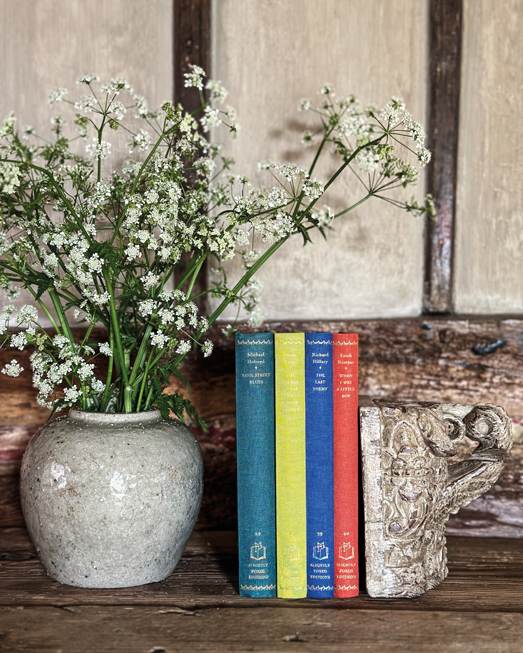


Wow, I was just about to place an order for the Adrian Bell set, but I now see, unlike what I read just days ago, that it’s sold out. If this isn’t the worst case of procrastination, I don’t know what is.