


Header overlay

What excellent company you are!

I have been devoted to your podcast for over a year; it could be improved only by being more frequent. Every book I have ordered from you has been a delight; nothing disappoints. I receive your emails with pleasure, and that’s saying a lot. Slightly Foxed is a source of content . . . ’
K. Nichols, Washington, USA

Popular categories

Explore our library

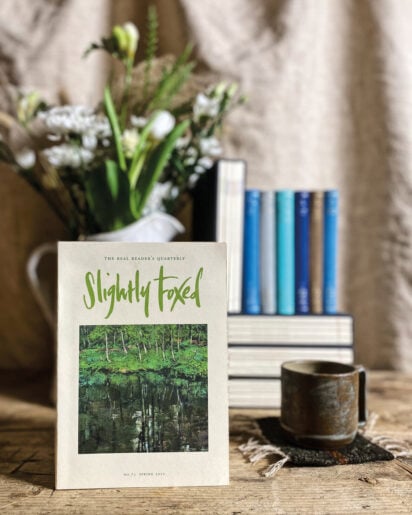
Cover Artist: Slightly Foxed Issue 52, Mark Hearld, ‘Papercut Foxes’

Cover Artist: Slightly Foxed Issue 52, Mark Hearld, ‘Papercut Foxes’

Born in 1974, Mark Hearld studied illustration at Glasgow School of Art and then completed an MA in Natural History Illustration at the Royal College of Art. Taking his inspiration from the flora and fauna of the British countryside, he works across a number of mediums, producing limited-edition lithographic and linocut prints, paintings, collages and hand-painted ceramics. He has completed commissions for Faber & Faber, Tate Museums and Walker Books. In 2012 Merrell Books published Mark Hearld’s Work Book – the first book devoted to Mark’s work.
An Antidote to Self-pity

An Antidote to Self-pity

‘Where am I?’ a soldier asks Pamela Bright in the first line of Life in Our Hands (1955). ‘In a field hospital,’ she replies, and moves on down the line of beds to the next patient. And that is all we know for the first ten pages of this book. It is three o’clock in the morning, ‘the very bottom of time’, and her ward is filled with wounded men. Some can be saved. Some, like Tom Malone, his liver ripped in two, cannot. He mumbles the Lord’s Prayer, cries out for his mother. Bright administers morphine, holds his hand, feels shame at the futility of her care.
George Orwell | The Nightmare of Room 101 | From the Slightly Foxed archives

George Orwell | The Nightmare of Room 101 | From the Slightly Foxed archives

Greetings from Hoxton Square. It’s Banned Books Week and censored writers have been very much on our minds: Simone de Beauvoir, D. H. Lawrence, Voltaire, Edna O’Brien, Kurt Vonnegut, Antal Szerb, James Joyce and Radclyffe Hall, to name but a few of our favourites. We have been astonished to discover quite how many books have been banned and the myriad reasons for which they were removed from libraries and bookshops around the world.
A Modest Proposal

A Modest Proposal

Two Puffins are in front of me, picked almost at random from my bookcase. And by Puffins I mean Puffin books, represented by that cheerful little bird on the spine which was for my formative reading years pretty well a guarantee of a good read. Eusebius the Phoenician by Christopher Webb was published in Britain by Puffin in 1973, The Dancing Bear by Peter Dickinson in 1974. Both captivated me; both satisfied the story-craving in the way a good dinner settles a hungry stomach.
SF magazine subscribers only
Cover Artist: Slightly Foxed Issue 51, Olivia Lomenech Gill, ‘Vasalisa’s Garden’

Cover Artist: Slightly Foxed Issue 51, Olivia Lomenech Gill, ‘Vasalisa’s Garden’

Olivia is a professional artist. In recent years she has also worked on illustration after being commissioned to design and illustrate a book for Michael and Clare Morpurgo with Templar Publishing. This was shortlisted for the Kate Greenaway Medal in 2014 and nominated for the International Biennale of Illustration in Bratislava. Olivia lives and works in Northumberland, with her husband, a paper conservator, with whom she shares a dedicated print and conservation studio.
The Loss of Innocence

The Loss of Innocence

I had been reading Philip Larkin’s poetry for years before, quite recently, I decided to have a look at his novels. I knew he had written a couple in his early years: Jill (1946) and A Girl in Winter (1947). I knew too that, in their Oxford days and for some while after, Larkin saw himself as primarily a novelist, while his friend Kingsley Amis regarded himself as primarily a poet (how wrong they both were). What I did not know was that, of Larkin’s novels, the second, A Girl in Winter , far from being an early misfire, is, well, a bit of a masterpiece.
SF magazine subscribers only
Frivolity, Filth and Fortitude

Frivolity, Filth and Fortitude

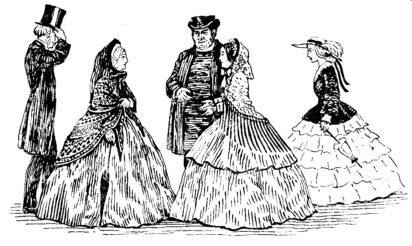
Among the excesses marking the dying days of the Bourbon ancien régime before it was swept away by the French Revolution was a craze for ridiculous hats. These structures elevated already flamboyant society coiffures to a level bordering on lunacy. Constructed from materials such as papier-mâché́, feathers and silk, they were worn to mark con- temporary events, from the death of a fêted individual to innovations such as ballooning. However, in a crowded field of eccentricity none could match the Duchesse de Lauzun who entered Mme du Deffand’s salon sporting an ‘entire tableau consisting of a stormy sea, ducks swimming near the shore and a man with a gun sprouting from her head. Above, on the crown, stood a mill with the miller’s wife being seduced by a priest, while over one ear the miller could be seen leading his donkey.’
SF magazine subscribers only
Mooching Around With Maigret

Mooching Around With Maigret

Fifteen years ago I set out to invent a fictional detective to lead a series that I hoped would stretch to half a dozen novels. The great imperative was to come up with a character I could live with, a sort of notional flatmate whose habits, tics and jokes I would still be able to tolerate over a span of five or six years. To date Titus Cragg and I have cohabitated more than twice as long, and I still have no inclination to ask for his keys and show him the door.
SF magazine subscribers only

Sign up to our e-newsletter

Sign up for dispatches about new issues, books and podcast episodes, highlights from the archive, events, special offers and giveaways.