Header overlay

Rosemary Sutcliff and the Magic of Childhood Reading

There is nothing more exciting than seeing children captivated by the magic of stories, and for many of us there’s no better children’s storyteller than Rosemary Sutcliff. Rebeka Russell, publisher of Manderley Press, joins us to share her enthusiasm for the author who inspired her love of literature at a young age and reads from her favourite of Sutcliff’s many books, The Armourer’s House.

Our second guest, Sam Leith, author of The Haunted Wood: The History of Childhood Reading, then takes us into the enchanted world of children’s books and we discuss the importance of both childhood reading and reading to children. Sam’s insights into the development of stories, from oral storytelling to myths, legends, folklore and fairytales, are fascinating and explain how the endless retelling of stories lies at the core of children’s books.

The themes that run through such books (adventures, escape from the structure of adult life and facing the dangerous world on your own) resonate throughout Sutcliff’s work. Although she did not learn to read until she was 9, her mother read Celtic and Saxon legends to her, which fed her imagination and inspired her love of folklore and history. As a child Rosemary suffered from chronic juvenile arthritis and as a result was severely disabled. Like other authors with a difficult childhood, her books always feature a character who is different and is often left on the sidelines, and in her signature she incorporated a dolphin as a symbol of freedom. Initially trained as an artist and miniaturist, she had an extraordinary attention to detail which is reflected in her books’ vivid descriptions of both people and places.

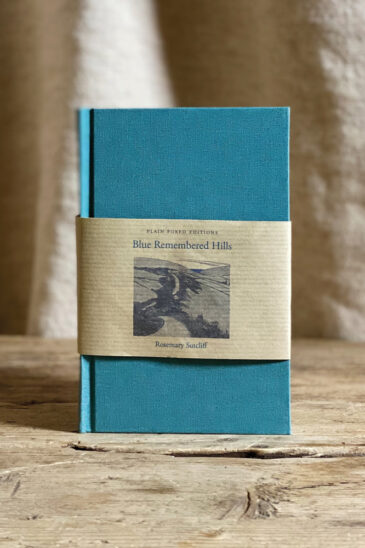
From the perfection of her memoir Blue Remembered Hills (available from  Slightly Foxed) to her historical novels about the Roman occupation of Britain, the Dark Ages, and Norman and Tudor times, Sutcliff’s extraordinary imagination lives on in the canon of children’s writing.

This episode’s recommended reads were Carlo Rovelli’s On the Equality of All Things, Frank Cottrell-Boyce’s autobiography A British Childhood and Susan Hill’s series featuring the detective Simon Serailler.

How to listen

There are several ways to listen to the podcast.

  • – LISTEN ONLINE

    Press the play button on the large image above to listen on this page or follow the link below to listen on Audioboom.

  • – DOWNLOAD

    Download an mp3 file of this episode to your device by following this link and clicking on ‘Download original audio’ on the right hand side. NB The file will download automatically on clicking the link. Please check your downloads folder.

Show Notes

Books Mentioned

Please find links to books, articles, and further reading listed below. We may be able to get hold of second-hand copies of the out-of-print titles mentioned on the podcast and listed below. Please get in touch with the Slightly Foxed office for more information. The digits in brackets following each listing refer to the minute and second they are mentioned. (Episode duration: minutes; seconds)

Subscribe to Slightly Foxed magazine

Sam Leith, The Haunted Wood: A History of Childhood Reading (1:42)

Rosemary Sutcliff, A Set of Rosemary Sutcliff novels (2:18)

Rosemary Sutcliff, Blue Remembered Hills (2:26)

Rosemary Sutcliff, The Armourer’s House (3:19)

Aesop’s Fables (6:46)

Sara Wheeler, Jan Morris: A Life (11:45)

Ben Short, Burn: A Story of Fire, Woods, and Healing (11:51)

Christopher Milne, The Enchanted Places (12:10)

Slightly Foxed Issue 92 (12:34)

James Woodforde, The Diary of a Country Parson (12:38)

Henry James, The Turn of the Screw and Other Ghost Stories (12:40)

Charles Dickens, The Pickwick Papers (12:41)

Tallulah Bankhead, Tallulah: My Autobiography (12:45)

Penelope Lively, Pack of Cards (12:50)

Zofia Nałkowska, Medallions (12:54)

Jill Barklem, The Complete Brambly Hedge (13:01)

Rudyard Kipling, Puck of Pook’s Hill (17:03)

Rudyard Kipling, Just So Stories (17:06)

Rosemary Sutcliff, The Eagle of the Ninth (17:50)

Rosemary Sutcliff, The Chronicles of Robin Hood (21:34)

Rosemary Sutcliff, Beowulf: Dragonslayer (22:01)

Rosemary Sutcliff, Tristan and Iseult (22:02)

Rosemary Sutcliff, Black Ships Before Troy: The Story of the Iliad  (22:03)

Rosemary Sutcliff, The Wanderings of Odysseus: The Story of the Odyssey (22:04)

Frances Hodgson Burnett, Little Lord Fauntleroy (28:55)

Frances Hodgson Burnett, The Secret Garden (29:33)

Arthur Ransom, Swallows and Amazons (29:40)

Kenneth Grahame, The Wind in the Willows (35:02)

Rosemary Sutcliff, Sun Horse, Moon Horse (38:17)

Rosemary Sutcliff, The Witch’s Brat (39:08)

Frank Cottrell-Boyce, A British Childhood: How Our Children Live Now (51:58)

Carlo Rovelli, On the Equality of All Things (53:51)

Susan Hill, The Magic Apple Tree (55:49)

Susan Hill, The Woman in Black (55:54)

Susan Hill, The Various Haunts of Men (56:17)

Related Slightly Foxed Articles

–The Truth of the Heart, Hazel Wood on Rosemary Sutcliff, Blue Remembered Hills, Issue 17

–Ancient Worlds, David Gilmour on Rosemary Sutcliff, The Lantern Bearers, Issue 4

  • The Truth of the Heart
    1 March 2008

    The Truth of the Heart

    I grew up in a house on the edge of a cliff, looking out over a bay. There was an upstairs drawing-room which was never used, and in the evenings when I was a little girl, I would go up there and close the door. Kneeling on the window-seat, I would gaze out at the sunset over the sea and the clouds banking on the horizon, and escape into my imagination. In those clouds I saw horses and chariots, marching legions, the thronged streets of medieval towns, knights in armour, great ships in full sail on a golden sea – vivid images from the books my father read me. The worlds they conjured up were consoling and utterly real to me, and I lived in them more than I lived in the present.
  • Ancient Worlds
    1 December 2004

    Ancient Worlds

    I was thus apprehensive, for my sake as well as my children’s, when I encouraged them to read Rosemary Sutcliff. I wondered whether I would still be drawn to her ancient worlds, her vanished races among the Caledonian Forest, her harpers and her war hosts, her bonfire festivals of Lammas and Beltane, her mead horns at Saxon feastings, her evocations of the last of Roman Britain. I need not have worried. The magic was still there. In his pantheon of literary heroes and heroines, Giuseppe di Lampedusa reserved the highest places for the authors he called creatori di mondi. Rosemary Sutcliff was such a writer, a creator of worlds, lost worlds, often worlds of lost causes, of the departing legions, of Arthurian Britain, of the last stand of the Lakeland Norsemen against the knights of William Rufus. But they are not simply worlds of battle-axes and war horns. Her imagination encompassed the natural world, a feeling for its rites and a knowledge of its workings. Some of her most beautiful passages describe the changing of seasons, the ways of wolf packs, the flights of wild geese, the solitudes of the east coast marshes. And no one (except perhaps Kipling) has handled the death of a devoted dog better than she did in Dawn Wind.

Other Links

–National Year of Reading 2026 | National Literacy Trust

–Manderley Press

Opening music: Preludio from Violin Partita No. 3 in E Major by Bach

Hosted by Rosie Goldsmith
Produced by Philippa Goodrich


Comments & Reviews

Leave a comment

Your email address will not be published.


Sign up to our e-newsletter

Sign up for dispatches about new issues, books and podcast episodes, highlights from the archive, events, special offers and giveaways.