


Header overlay

What excellent company you are!

I have been devoted to your podcast for over a year; it could be improved only by being more frequent. Every book I have ordered from you has been a delight; nothing disappoints. I receive your emails with pleasure, and that’s saying a lot. Slightly Foxed is a source of content . . .
K. Nichols, Washington, USA

Popular categories

Explore our library

Hons and Rebels | The Society of Hons

Hons and Rebels | The Society of Hons

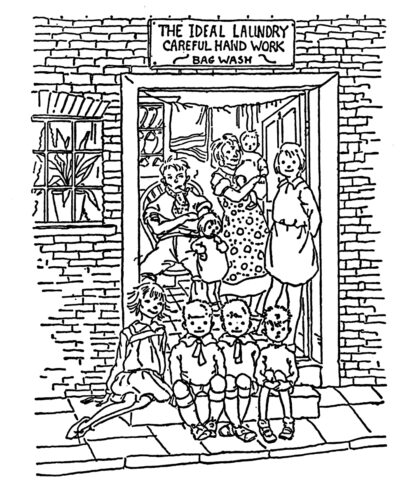
Unity and I made up a complete language called Boudledidge, unintelligible to any but ourselves, into which we translated various dirty songs (for safe singing in front of the Grown-Ups) and large chunks of the Oxford Book of English Verse. Debo and I organized the Society of Hons, of which she and I were the officers and only members. Proceedings were conducted in Honnish, the official language of the soci­ety, a sort of mixture of North of England and American accents. Contrary to a recent historian’s account of the ori­gin of the Hons, the name derived, not from the fact that Debo and I were Honourables, but from the Hens which played so large a part in our lives. These hens were in fact the mainspring of our personal economy. We kept dozens of them, my mother supplying their food and in turn buying the eggs from us – a sort of benevolent variation of the share-cropping system. (The H of Hon, of course, is pro­nounced, as in Hen.)
Literary Gifts & Fantastic Foxes | From the Slightly Foxed Emporium

Literary Gifts & Fantastic Foxes | From the Slightly Foxed Emporium

Greetings from SF HQ, where life may be imitating art as we carry tall towers of books to the packing desk ready to wrap and dispatch to our dear readers. However, rest assured that we’re looking much more cheerful (and being more careful!) than these fully foxed figures in Quentin Blake’s cover artwork for Slightly Foxed Issue 24. And thankfully Dusty the office dog is safely snoozing on the sofa rather than getting under our feet like this book-thieving fox . . . There is still time to add to our packing piles and post bags before the year is out, and you’ll find books and goods, seasonal reads and stocking fillers in our online emporium. And, in honour of SF contributor Quentin Blake turning 90 this Friday, we’re also recommending a selection of pocket-sized titles bearing his fantastic, often foxy, illustrations.
‘Smashing little hardbacks’ | Slightly Foxed Editions

‘Smashing little hardbacks’ | Slightly Foxed Editions

Greetings from a busy, book-filled Slightly Foxed office, where we’re merrily navigating our way through an obstacle course of post bags, packing materials and parcels. There’s still time for us to help with gifts for booklovers, and we’d like to shine a light on our Slightly Foxed Editions – beautifully produced cloth-bound hardbacks, just the right size to hold in the hand and with a ribbon marker to keep your place. And, if you have missed out on a title or two from our series of limited-editions, our Plain Editions come in the same neat pocket format as the original SF Editions and will happily fill any gaps in your collection – as well as forming a delightful uniform series of their own, each bound in duck-egg blue cloth. Perfectly designed to curl up with, these classic titles are highly individual and absorbing reads.
Period Piece | Chapter VII: ‘Aunt Etty’

Period Piece | Chapter VII: ‘Aunt Etty’

I have defined Ladies as people who did not do things themselves. Aunt Etty was most emphatically such a person. She told me, when she was eighty-six, that she had never made a pot of tea in her life; and that she had never in all her days been out in the dark alone, not even in a cab; and I don’t believe she had ever travelled by train without a maid. She certainly always took her maid with her when she went in a fly to the dentist’s. She asked me once to give her a bit of the dark meat of a chicken, because she had never tasted anything but the breast. I am sure that she had never sewn on a button, and I should guess that she had hardly ever even posted a letter herself. There were always people to do these things for her. In fact, in some ways, she was very like a royal person. Once she wrote when her maid, the patient and faithful Janet, was away for a day or two: ‘I am very busy answering my own bell.’ And I can well believe it, for Janet’s work was no sinecure. But, of course, while Janet was away, the housemaid was doing all the real work; and Aunt Etty was only perhaps finding the postage stamps for herself, or putting on her own shawl – the sort of things she rang for Janet to do every five minutes all day long.
1st March 2023

Slightly Foxed Issue 77: From the Editors

There’s something very particular about the quiet months after Christmas – a time to hibernate, turn round and generally take stock. That’s what we’ve been doing here at the Slightly Foxed office, tidying up after the Christmas rush, reviewing our plans for the coming year and watching spring gradually arrive in Hoxton Square as the daffodils begin to emerge and the cafés tentatively put out their tables.
- Gail Pirkis & Hazel Wood
From the editors
Waiting for Posterity

Waiting for Posterity

In 1786 Richard Wynne decided to sell his estate at Folkingham in Lincolnshire and go to live on the Continent with his wife and five daughters. The sale realized £90,000 and he had investments too; his wealth, eight figures in today’s terms, meant he could lead as elaborate an existence as he wanted, and the hope was that his wife’s health would be improved by living abroad. Moreover she was French, while his mother had been Italian and he had spent part of his youth in Venice, so perhaps it wasn’t as radical a step as all that. Then his fifth daughter had been born in 1786, so he might have resigned himself to never having a male heir to inherit Folkingham.
SF magazine subscribers only
The Prince, the Showgirl and Me | From the Slightly Foxed bookshelves

The Prince, the Showgirl and Me | From the Slightly Foxed bookshelves

Introducing the latest addition to the Slightly Foxed Editions list, No. 61: The Prince, the Showgirl and Me It is 1956, and through a combination of chutzpah and some useful contacts (he is after all the son of Lord Clark of Civilisation), the young Colin Clark has got himself a job. He’s now a ‘gofer’ or general dogsbody on the Pinewood Studios set of The Prince and the Showgirl, a light comedy starring Sir Laurence Olivier (abbreviated in the diary Colin is beadily keeping to SLO) and Marilyn Monroe (MM) as the two leads. This unlikely combination proves to be a disaster. Marilyn fails to turn up on time and can barely remember her lines, while Sir Laurence is completely out of his depth with both her and her entourage. Marilyn is a troubling enigma – impossible to deal with, yet possessed of some indefinable magic that made her irresistible on screen when the ‘rushes’ come through, often upstaging Sir Laurence. The film does eventually get made and sinks without trace, but fortunately Colin Clark is there to record the agonies of its making in this sharp and hilarious diary.
Ronald Blythe | From the Slightly Foxed archives

Ronald Blythe | From the Slightly Foxed archives

Greetings from Hoxton Square, where we’re raising a glass to the nature writer and Slightly Foxed contributor Ronald Blythe as he turns 100. He lives at the end of an overgrown farm track deep in the rolling countryside of the Stour Valley, on the border between Suffolk and Essex. His home is Bottengoms Farm, a yeoman’s house once owned by John Nash, and from here he has spent many decades observing, in a series of lyrical diaries, the slow turn of the agricultural cycle, the church year, and rural change and continuity. A new selection of these writings, Next to Nature: A Lifetime in the English Countryside, has just been published to celebrate his 100th birthday. Please join us as we return with pleasure to Maggie Fergusson’s article from Slightly Foxed Issue 11, written in praise of Akenfield, Blythe’s famous portrait of an English Village.
The Young Ardizzone | From the Slightly Foxed bookshelves

The Young Ardizzone | From the Slightly Foxed bookshelves

There can be few author-illustrators whose books are remembered – and still read – with such affection as those of Edward Ardizzone. And affection is the keynote of this charming memoir, The Young Ardizzone, which brings alive in words and pictures the comfortable Edwardian world in which Ardizzone grew up. The creator of the ever-popular Little Tim and Lucy books begins his story in 1905 when he was 5 and his mother brought him and his two sisters home to England from Haiphong where his father was a telegraph engineer. Left in Suffolk in the care of their grandmother, the three grew up with a full complement of young bachelor uncles, great-aunts and eccentric family friends – all beautifully and often poignantly captured in Ardizzone’s deceptively simple prose and delicately humorous drawings. This classic memoir is a must for fans of Ardizzone, young and old, and a perfect introduction for those who haven’t yet discovered him. We’re delighted to announce that it will be available to readers once more, published in a Plain Foxed Edition.
‘String is my foible’

‘String is my foible’

A tarnished silver teapot. A tin of buttons, their parent garments long decayed. A bundle of yellowing letters, in my mother’s hand. Look: here she is, smiling in her nurse’s uniform in the photograph that used to sit upon the mantelpiece. But now she’s propped against moving boxes, still not unpacked. These are a few of the reasons why I cannot sit in my own front room, although there are more. It’s no use turning to Marie Kondo in this sort of situation; what I recommend is Elizabeth Gaskell. The narrator of Cranford (1851–3) knows all about hoarding. ‘String is my foible. My pockets get full of little hanks of it, picked up and twisted together, ready for uses that never come.’ And elastic bands – or, as Cranford puts it, India-rubber rings. Oh, don’t talk about India-rubber rings! ‘I have one which is not new,’ our narrator tells us, ‘one that I picked up off the floor, nearly six years ago. I have really tried to use it: but my heart failed me, and I could not commit the extravagance.’
SF magazine subscribers only
Shall I Be Me?

Shall I Be Me?

In the summer of 1953, briefly in London during the Coronation celebrations, I took myself to the Phoenix theatre (Upper Circle, 6s.) to see The Sleeping Prince, with the two glittering stars of the time, Laurence Olivier and his wife Vivien Leigh. Olivier had commis­sioned the piece especially for the season from the playwright Terence Rattigan, and the paper-thin plot had the Regent of Carpathia, in town for the 1911 Coronation, reluctantly mesmerized by a chorus girl. No play embellished by Olivier and Leigh could fail to captivate a popular audience, and this one had a good run – but for those with a more robust appetite it was really nothing more than a moderately tasty meringue.

Sign up to our e-newsletter

Sign up for dispatches about new issues, books and podcast episodes, highlights from the archive, events, special offers and giveaways.