

Header overlay

Articles & Extracts

A Tale of Two Villages

A Tale of Two Villages

For many people in the countryside, life just after the Second World War had not changed so very much from a hundred years before. When I was a young boy in the 1950s our family lived in a small farmhouse in mid-Wales, a couple of miles from the nearest village. We had no mains water or electricity; water came from a well through a hand pump in the kitchen; electricity was provided by a generator – when that burned out one night in November we relied on candles and oil lamps for the whole winter. There was no bathroom, only a tin bath hung on the kitchen door, and an outside privy. Neighbouring farms were much the same, and families scratched a living from the sheep dotted on the surrounding hills. The children spoke Welsh and English and sang Welsh songs on the school bus. Most people went to Chapel on Sunday. It all seemed perfectly normal and likely to last forever.
SF magazine subscribers only
Murder, Miracles and Myanmar

Murder, Miracles and Myanmar

As I had expected, I found the famous murder trials edited by Miss F. Tennyson Jesse on the shelves of the Law Library of the University of Victoria on Vancouver Island, but I was pleasantly surprised to discover a dozen more of her books in the main collection. It is a very young university – a mere sixty years old – and it replaced Victoria College, which itself had absorbed the Normal School, as the teacher training institute was originally known, and naturally took over their libraries. Presumably the young women preparing to be junior school teachers in the 1920s and ’30s enjoyed Jesse’s novels and plays, and so obviously did their instructors and the librarians, who of course make the real decisions about library purchases.
SF magazine subscribers only
Last of the Swallows

Last of the Swallows

It is a truth universally acknowledged that the perfect happiness of progeny is achieved only in the absence of their parents. As such circumstances are normally attended by certain obvious practical difficulties and disadvantages, they are to be found less in daily life than in fiction. In the twelve books of the Swallows and Amazons series, Arthur Ransome is ingenious in providing good reasons for keeping their elders and betters out of the revels of the Walker, Blackett and Callum children. In the seventh of the series he is at his most adept in placing Commander Walker in the wings but off stage until the precise moment when he is needed at the climax of the tale.
SF magazine subscribers only
1st June 2022

Slightly Foxed Issue 74: From the Editors

Summer is here and the square outside has come alive again. There are people walking their dogs or enjoying the sunshine at tables outside the café opposite the office. It’s a peaceful scene, but it’s impossible to forget that far away though ever-present is this year’s ugly backdrop of the war in Ukraine, not to mention the violence and suppression of free speech in so many parts of the world. We’ve never taken ourselves too seriously at Slightly Foxed, seeing it as essentially a place where readers can relax, enjoy good writing and, we hope, have a laugh occasionally. But in these deeply worrying and isolating times, it’s the comforting sense of fellowship and connection through books that readers tell us they get from Slightly Foxed which seems especially important.
- Gail Pirkis & Hazel Wood
From the editors
Another Self | Chapter I: Tobias and the Angel

Another Self | Chapter I: Tobias and the Angel

My world was the only real world. Nothing about it seemed incongruous; and those events which happened in it were never inconsequential. Its relation with the great outside world was tenuous. By which I do not deny that a few of my notable fancies were sparked off by momentous contacts with the unreal, outside world. For of course they often were. A riveting story or a glamorous present might do the trick, and set the magic working. On the other hand the pattern of events in my world was often outrageously disturbed by trivial demands made by the unreal world, such as to eat tapioca pudding, to wash my teeth, or to go to bed when I felt disinclined.
Conundrum | Chapter 7: Rescued – a grand love . . .

Conundrum | Chapter 7: Rescued – a grand love . . .

Love rescued me from that remote and eerie capsule, as it rescued me from self-destruction, and everything they say about love, in dicta sublime as in lyric abysmal, is demonstrably true. I have loved people with disconcerting frequency all of my life, but I have enjoyed one particular love of an intensity so different from all the rest, on a plane of experience so mysterious, and of a texture so rich, that it overrode from the start all my sexual ambiguities, and acted like a key to the latch of my conundrum.
A Year in Barsetshire

A Year in Barsetshire

In the spring of 2020, amidst the early devastation of Covid-19, I found myself unable to read. I was grappling with the after-effects of an accident when the pandemic struck, so my concentration was already fractured by the time the streets fell silent. Deprived of the consolations of print, one April afternoon I pressed play on the first chapter of the audiobook of Anthony Trollope’s The Warden as I left the house for my daily walk. I did so without much expectation that the noise would do anything other than provide a mild distraction from the exigencies of the day, but within minutes the cathedral close of Barchester had opened up before me and I was hooked. What follows is an account of the year I spent among the inhabitants of Barsetshire, and of the solace I found in the connected stories of the Barchester novels.
SF magazine subscribers only
Masefield’s Magic

Masefield’s Magic

I was 8 when I first read John Masefield’s The Box of Delights – in the late 1960s, in the high-ceilinged classroom of a Victorian-built school in East London. I had not long been reading ‘chapter books’ as we called them, and this was the longest, most challenging and most sophisticated one I had yet encountered – and by far the most rewarding. It’s not easy to convey the peculiar atmosphere of it: scary but funny; fantastical but believable; lyrical yet down-to-earth; grotesque, even nightmarish in parts, yet told in a friendly voice. Years later, when I had forgotten most of the details of the actual story and characters, the feeling of it remained with me, like the lingering memory of a dream.
SF magazine subscribers only
A Glorious Menagerie

A Glorious Menagerie

‘Of all the civilizations of the ancient world, none enjoyed such a close and significant relationship with the animal realm as that of the ancient Egyptians.’ So Philippe Germond, an Egyptologist at the University of Geneva, plunges into his subject in An Egyptian Bestiary (2001). But already he is outflanked on the facing page by the regal profile of a leopard’s head carved in sunken relief, the sharply incised contour framing it with a powerful line of shadow. Which is fitting, for this is above all a picture book, led by 280 spectacular photo­graphs (mostly credited to his co-author Jacques Livet) of artworks that speak across the millennia and challenge the imagination.
SF magazine subscribers only
Fulmar, Gannet and Puffin

Fulmar, Gannet and Puffin

In shelves to the left and right of the fireplace in our dining-room, my husband keeps an extensive collection of books about Scotland. Half a shelf is given over to volumes on St Kilda. If ever I feel the need to escape from Hammersmith to a landscape of vast skies, mountainous waves, sea-spray blowing like white mares’ tails across the rocks, this is where I turn: to the extraordinary archipelago, 110 miles west of the Scottish mainland, whose black cliffs and dizzying stacks, the highest in Britain, unfold in a drumroll of Gaelic names – Mullach Mor, Mullach Bi, Conachair.
SF magazine subscribers only
The Art of Bookselling

The Art of Bookselling

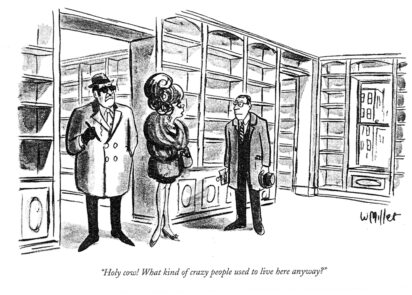
Just as most good books aren’t really about the things they say they are, Penelope Fitzgerald’s The Bookshop (1978) isn’t really about a bookshop. It’s about English insularity, politics, the misuse of power and the headstrong persistence of hope, with Florence Green’s Suffolk bookshop a symbol for every newcomer who ever found their best intentions beaten down by suspicion and hidebound tradition. At the end of the book, the formidable local matriarch Mrs Gamart manipulates her MP nephew into pushing through Parliament a bill specifically designed to close down Florence’s shop in favour of a local arts centre. The arts centre is Mrs Gamart’s pet project, and the town of Hardborough falls into line behind her. Florence has to con­clude that ‘the town in which she had lived for nearly ten years had not wanted a bookshop’. That is the last line of a book about a book­shop. An upbeat ending it is not.
SF magazine subscribers only
Not So Verray Parfit

Not So Verray Parfit

I once taught English at a girls’ school in which the head of depart­ment didn’t like poetry. It’s an odd aversion but it worked well for me. The poetry room was right at the top of a very tall building, and thither wended her way every pupil in the place, to be rewarded by peaceful sessions chewing over every kind of poem, from epic to lyric to limerick. But some of these girls also had to pass public exams. The A-level syllabus was dictated by a higher authority and this term the poetry module featured Chaucer. No problem in that. To me, he is the tops. He understood the complicated, subtle, self-deluded and some­times glorious nature of human beings better than any writer, before or since, and he displayed enough humour, generosity and lightly worn erudition to keep a whole pilgrimage entertained from here to eternity.
SF magazine subscribers only
Following the Music

Following the Music

As deputy literary editor of the Independent on Sunday in the mid-1990s, it was my job to organize and compile several of the routine book columns and features every week. One such was the long-running ‘The Book that Changed Me’. It involved typing up a short telephone interview with a literary or other type of celebrity; less frequently, the contributor would write the copy themselves. It can be difficult to drum up fresh ideas once a column has been underway for some time, but we never ran short of suggestions and contribu­tions. One highlight for me was hearing Christopher Lee declaim at length down the line in Elvish, in his fanatical enthusiasm for The Lord of the Rings. I can only imagine how delighted he must have been to be offered the part of Saruman.
SF magazine subscribers only

Sign up to our e-newsletter

Sign up for dispatches about new issues, books and podcast episodes, highlights from the archive, events, special offers and giveaways.