


Header overlay

Articles & Extracts

A Nasty Business

A Nasty Business

H. G. Wells’s The War of the Worlds (1897) has long been one of my favourite books. I first read it half a century ago – when I was about 10, to judge by the date on my Penguin edition (price 3/6d). I must have read it half a dozen times since; my battered copy is now held together with Sellotape. Recently I began watching a television adaptation: it was so disappointing that I abandoned it halfway through the first episode. This unhappy experience led me to question why it is that I like the book so much.
SF magazine subscribers only
Fidget Pie

Fidget Pie

Huffkins and Fleads, Surry Ponds and Manchets, Frumenty, Minnow Tansies and Fidget Pie. These evocative recipe titles were what first hooked me; fantastical-sounding to my ear, they might have sprung from the pages of a Lewis Carroll story. They were, in fact, authentic recipes in an extraordinary volume I found in a second-hand bookshop more than a decade ago called Good Things in England, by Florence White. It wasn’t Alice in Wonderland, but it led me down a rabbit hole of sorts. I’ve been obsessed with the book and its author ever since.
SF magazine subscribers only
1st December 2022

Slightly Foxed Issue 76: From the Editors

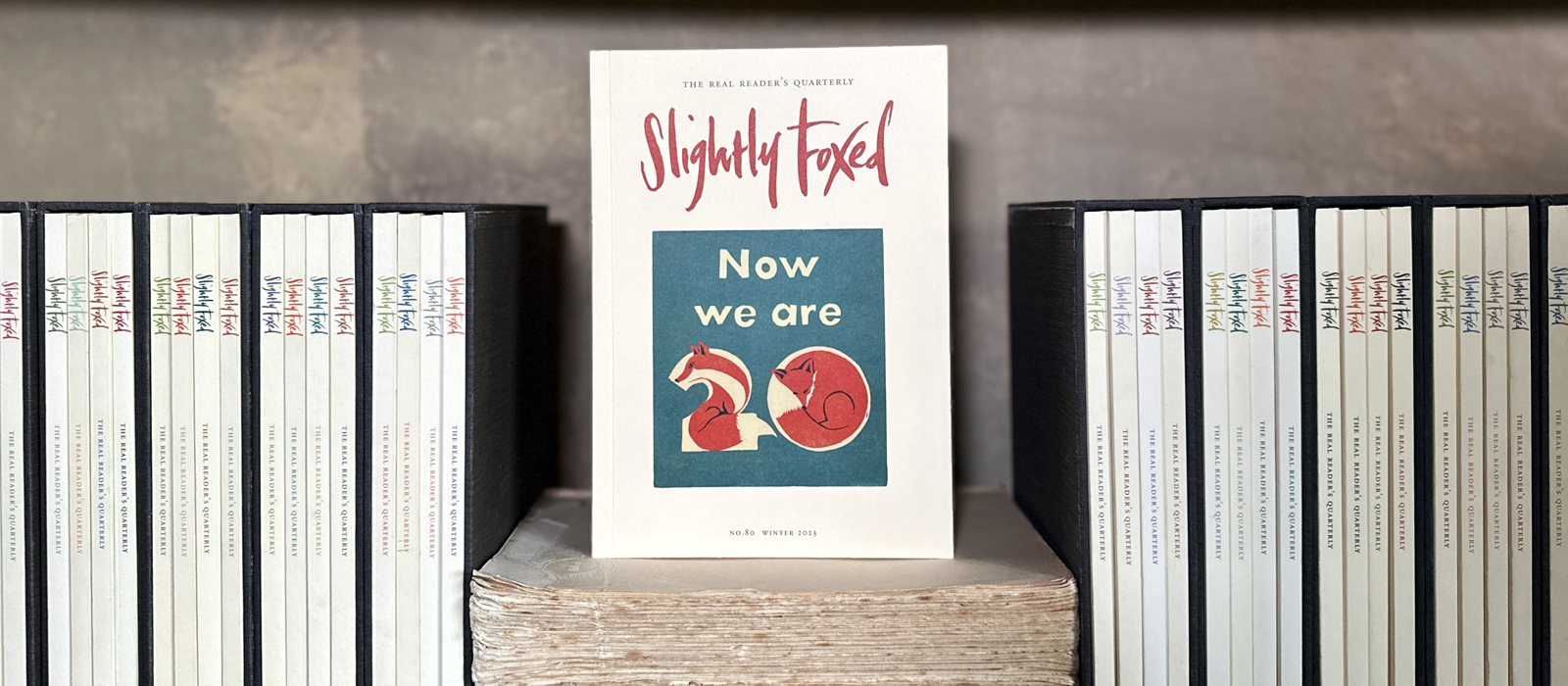
This issue of Slightly Foxed comes with our very best wishes to you all from all of us here for Christmas and the coming year. However there’s no escaping the fact that these are anxious times, and we were touched by a reader in Australia who wrote to us recently: ‘I can only say, to all the Slightly Foxed team, that you are a saviour. Slightly Foxed has kept me in touch, kept me sane, made me relish the humour, the warmth, the quirky charm of the English way of doing things.’ Wherever you are in the world, we hope you feel the same.
- Gail Pirkis & Hazel Wood
From the editors
The House of Elrig | Chapter I: The House

The House of Elrig | Chapter I: The House

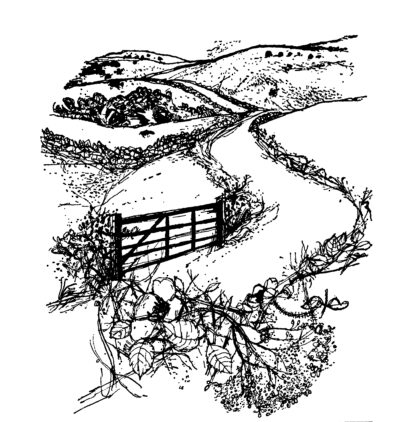
You can see the house from a long way off, a gaunt, grey stone building on a hillside of heather and bracken. The road, very narrow, has climbed two or three hundred feet from the sea; slanting at first from the grey boulder beach up near-cliffs of coarse grass, bracken and thorn scrub, the few trees stunted and deformed by incessant westerly winds, so that their limbs and their heads seem to be forever bowed and straining towards the land; on and up, winding through poor agricultural land, where the fields with their rough dry stone walls alternate with patches of scrubland, thorn bushes and briar thickets with the bare rock showing between them; through the tiny village of Elrig, with a smithy and a ruined mill but no shop; then, a mile on at the corner of a ragged fir wood sheltering a loch, is the turning to the house.
As I Walked Out One Midsummer Morning | Into Spain

As I Walked Out One Midsummer Morning | Into Spain

It was early and still almost dark when our ship reached the harbour, and when out of the unconscious rocking of sea and sleep I was simultaneously woken and hooked to the coast of Spain by the rattling anchor going over the side. Lying safe in the old ship’s blowsy care, I didn’t want to move at first. I’d enjoyed the two slow days coming down the English Channel and across the Bay of Biscay, smelling the soft Gulf winds blowing in from the Atlantic and feeling the deep easy roll of the ship. But this was Vigo, the name on my ticket, and as far as its protection would take me. So I lay for a while in the anchored silence and listened to the first faint sounds of Spain . . .
21st January 2026

Slightly Foxed Writers’ Competition (2026)

We feel it’s time for another of our Writers' Competitions. We’ve greatly benefited from them in the past, finding, predictably, that among our readers there are some very good writers. The competition is open to all current Slightly Foxed subscribers. The winner will receive a prize of £300 and the piece will be published in a future issue of the magazine. All entries should reach us by 15 January 2023.
- Gail Pirkis & Hazel Wood
From the editors
An Understanding Heart

An Understanding Heart

I can’t remember when I first read the magical trilogy that came to be known as Lark Rise to Candleford but, turning to it for comfort during the days of the 2020 lockdowns, I was struck afresh by the wonderful clarity and assurance of the writing. Most memoirs at the time Flora Thompson was writing were by comfortably educated, middle-class people, while she grew up as the daughter of a poor bricklayer in a small Oxfordshire village. Yet from the first sentence you feel the authenticity of her voice and know you are in the hands of an accom­plished writer. As her biographer Margaret Lane put it, ‘She was able to write the annals of the poor because she was one of them.’
In Nuristan with Carless

In Nuristan with Carless

Twenty years ago, I was due to give a talk at the Travellers Club about a recent expedition. I thought it would be much more entertaining for everyone if my friend Ned spoke about the perils of travelling with a travel writer. Eventually we also invited the retired diplomat Hugh Carless, a fellow victim, to talk about his own dire experiences at the hands of Eric Newby in A Short Walk in the Hindu Kush (1958). By then in his late seventies, Carless was charming, extremely modest and very funny. Rather unkindly, I thought, someone asked if his Foreign Office career had ever recovered from his merciless treat­ment. He laughed uncomfortably.
SF magazine subscribers only
Unsuspected Depths

Unsuspected Depths

My sister gave me Copsford (1948). It was clearly a book she loved, and its author – Walter Murray – was someone we’d once known. So it seemed odd I’d never heard of it. It’s a strange, exhilarating book about a solitary year spent wholly absorbed in the natural world – a book in the tradition that runs from Richard Jefferies to Robert Macfarlane and perhaps has roots in Wordsworth too, and John Clare in saner moments. But though it has devotees and is reissued now and then, it has never been widely read. In fact most people, like me, have never heard of it.
SF magazine subscribers only
Of Captains and Khans

Of Captains and Khans

Many years ago, when it was possible to do such things, I hitchhiked to India. I travelled through Iran and Afghanistan, saw the Great Buddhas at Bamiyan, and rode through the Khyber Pass on the roof of a brilliantly painted truck with my hair blowing in the wind. Later, as the world changed and carefree travel became more difficult, I came across Peter Hopkirk’s The Great Game (1990) and was thrilled to read about the adventures of the first western travellers to those regions in the nineteenth century.
SF magazine subscribers only
Boxing Days

Boxing Days

The jab that crunched into my nose before I had my guard up was a fine lesson in the importance of being prepared, but it is not a fond memory. Getting punched rarely is. A. J. Liebling, however, treasured the blow he received from ‘Philadelphia’ Jack O’Brien, an American pugilist already in his prime when Liebling was born in 1904. Liebling saw the punch as a precious relic, linking him to O’Brien’s era and the eras before that. Just think of the greats who had punched O’Brien, the greats who had punched them and so on back in time. Liebling was proud to be part of such a passage of punches.
SF magazine subscribers only
Dem Bones

Dem Bones

Some thirty years ago in the National Museum of Guyana, amidst the geological, archaeological and historical artefacts in their display cabinets, there existed a carefully cordoned-off empty space. It consisted of a plinth covered in plush red fabric surrounded by gold tasselled ropes, as if waiting for secret royalty. I am not sure how many other countries set aside a space in their national museums for their ghosts, spirits and jumbies. Not many, I imagine. Behind the empty space hung various plaques with detailed sociological descriptions of each spirit, itemizing its habitat, appearance, customary behaviour and even dietary preferences, an attempt by the rational with its orderly classifications and categorizations to contain or overpower these disturbing beings.
SF magazine subscribers only
Guilty Pleasures

Guilty Pleasures

More often than not, a shelf of books is a statement about the person we wish to be. We carefully arrange the titles so our friends will gain a favourable impression of us, thinking that we are cultured, sensitive, politically aware or part of the rebellious avant-garde. Meanwhile, the books we really enjoy, our guilty pleasures, are hid­den from sight. It’s nice to know that not much has changed in 500 years. Apparently, scholars in Ming-dynasty China did much the same. The books on display in their studies were the Confucian clas­sics they had been forced to read to gain high positions in the civil service, while the books they really enjoyed were hidden under their mattresses. And these, quite often, were pulp detective novels.
SF magazine subscribers only
Read, then Cook

Read, then Cook

‘If you can read, you can cook.’ This was the simple, revolutionary philosophy behind Mastering the Art of French Cooking (1961 and 1970), written by Julia Child, Simone Beck and Louisette Bertholle. Even with sixty years’ hindsight, the book’s lasting success is remark­able. In two volumes and running to well over a thousand pages of precise technical French cuisine it was launched on a nation of home cooks who knew little about la belle France, yet it became a runaway best-seller and catapulted one of its authors to fame.
SF magazine subscribers only

Sign up to our e-newsletter

Sign up for dispatches about new issues, books and podcast episodes, highlights from the archive, events, special offers and giveaways.